The primary goal of creating a MVP is not to build something, but instead to learn something.
Minimum Viable Product (MVP) is one of the most misunderstood terms in product management. It is often mistaken for a minimal feature set or a half-baked product. But the actual job of an MVP is quite different: to learn as much as possible about your customers with the least amount of effort and investment.
The trap many teams fall into is building a “minimum” product that is neither viable nor useful — it fails to engage any user and thus produces no learning. The honest truth is that an MVP must be viable enough to attract early adopters who are actively searching for solutions, not just anyone.
The rest of this lesson will teach you how to think about MVPs the right way, how to run MVP experiments, and how to use the insights to build better products.
MVP is about learning, not shipping
The classic definition of MVP comes from Eric Ries, author of The Lean Startup:
"The minimum viable product is that version of a new product which allows a team to collect the maximum amount of validated learning about customers with the least effort."
In other words, your MVP is an experiment designed to test your hypotheses about the product and its users. It is not a half-finished product you hope users will tolerate. It must deliver some core value to early adopters — those customers who are well aware of the problem and actively looking for a solution.
Who are these early adopters? They form the left side of the Product Adoption Curve:
| Segment | Percentage | Description |
|---|---|---|
| Innovators | 2.5% | The first to try new ideas, tolerant of rough edges |
| Early Adopters | 13.5% | Visionaries who recognize the value early and spread it |
| Early Majority | 34% | Pragmatists who want complete, reliable solutions |
| Late Majority | 34% | Skeptics who adopt after seeing broad adoption |
| Laggards | 16% | Resistant to change, adopt last |
Your MVP is targeted at Innovators and Early Adopters — the people who will give you honest feedback and help you validate your core assumptions.
The product creation journey and where MVP fits
Products start as ideas — innovative solutions to simple problems. The journey typically looks like this:
- Listen and observe your surroundings to identify problems hiding in plain sight.
- Brainstorm ideas and select a promising one.
- Plan the product details and design.
- Build the product.
- Launch and reveal your product to the world.
- Await user reactions and feedback.
The “moment of truth” happens at launch. But what if your entire investment was wasted because no one wants your product? The MVP helps you avoid that pitfall by testing your assumptions earlier and cheaper.
How an MVP experiment works
The MVP is not a one-time build — it is a continuous process of hypothesis testing, learning, and iteration.
Here is the overview:
-
Step 1: Voice of the customer
Listen closely to your target users to understand their pain points and needs. Ask: Who will buy this product? Why? How? -
Step 2: Identify assumptions
Every product idea carries assumptions. Some are riskier than others. Prioritize assumptions that, if wrong, would kill your product. -
Step 3: Form testable hypotheses
Convert assumptions into measurable hypotheses. For example, “At least 30% of users will use feature X weekly.” -
Step 4: Build the MVP
Build the smallest product that can validate or invalidate your hypotheses. It should be cheap and quick to build but viable enough to engage early adopters. -
Step 5: Collect data
Define metrics and methods to gather feedback: surveys, interviews, usage data. -
Step 6: Analyze and learn
Validate your hypotheses. If assumptions fail, pivot or iterate. -
Step 7: Iterate
Use learning to improve your product, expand features, or redefine the problem.
Sprint planning at a Series A startup in Bangalore
PM (You): “Our riskiest assumption is that college students will upload and share notes regularly.”
Engineering Lead: “Let’s build a simple web upload portal that tracks usage and feedback.”
Design Lead: “Keep the UX minimal — just enough to upload and share files.”
CEO: “Will this be enough for users to engage?”
PM (You): “Yes, it will help us validate if the problem and solution fit before investing more.”
Balancing speed with viability in MVP design
MVP examples to ground the concept
Example 1: Land shortage and apartment building
Imagine a town facing a land shortage. You suggest building a high-rise with multiple apartments. But will residents buy?
You build a basic building with minimal amenities quickly and open it to residents. The first occupants are early adopters who validate demand.
As residents move in, they provide feedback — requests for a gym, swimming pool, better maintenance. You use this feedback to improve future buildings.
This MVP approach eliminates long specification phases and expensive upfront investment. It builds learning into the product development.
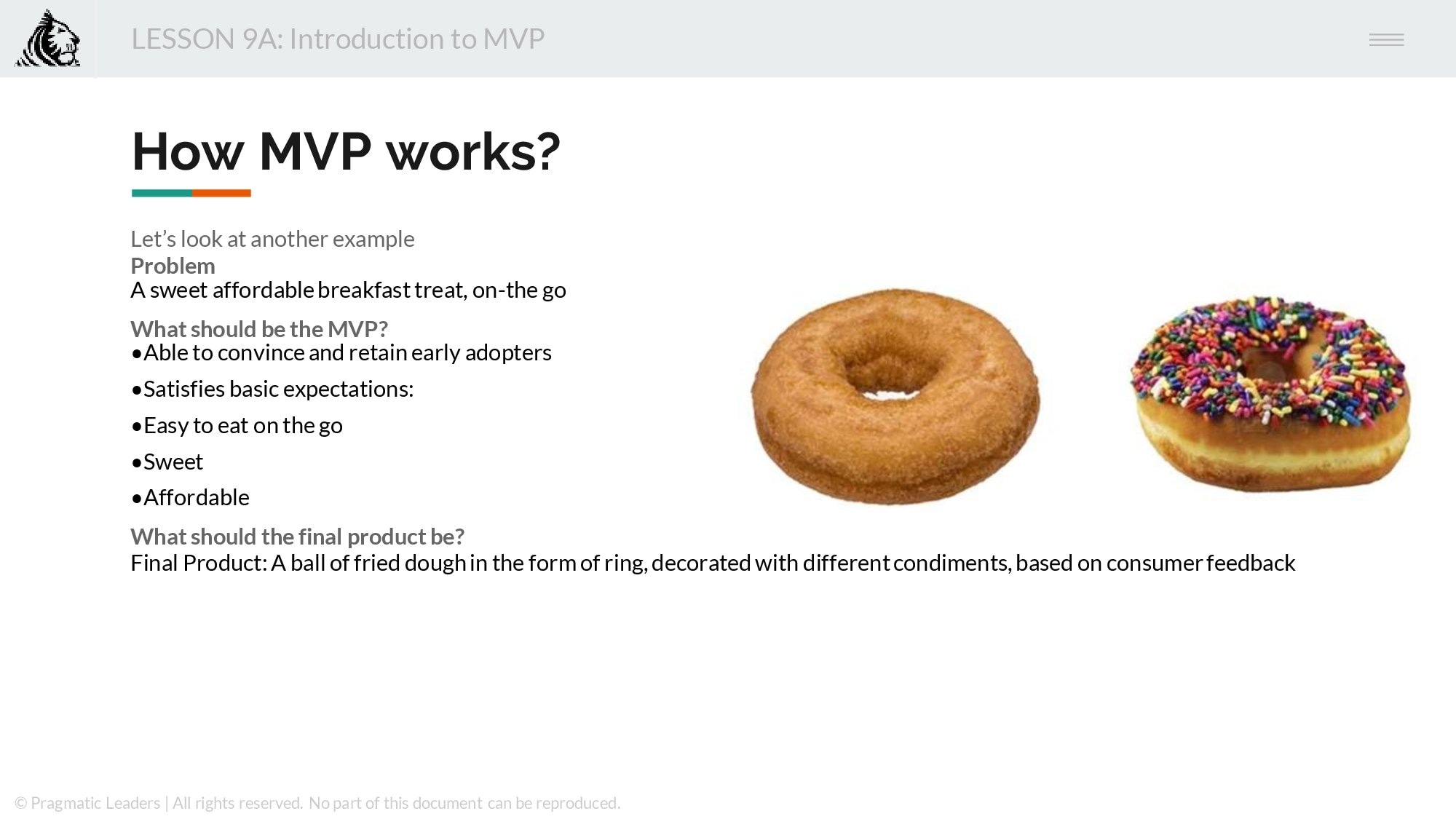
Example 2: Plain donut vs. decorated donut
Your problem: create a sweet, affordable breakfast treat on the go.
Your MVP: a plain fried dough ring — easy to eat, sweet, affordable.
The final product: a donut decorated with sprinkles and condiments based on consumer feedback.
The plain donut is enough to satisfy early adopters and gather insights to build the final product.
Characteristics of a good MVP
- Satisfies basic expectations of early adopters — it must be viable enough to use.
- Retains and engages early adopters — enough to gather meaningful feedback.
- Provides iterative feedback mechanism — to improve the product continuously.
As satisfaction increases, investment increases. The MVP sits at the threshold — enough to engage early users, but minimal to save time and cost.
Why MVP matters: usefulness and impact
- Lowers development cost significantly by avoiding building unnecessary features.
- Ensures faster go-to-market timelines — you test the market early.
- Ensures the product being developed is truly desired by the target audience.
The MVP puts you in close contact with customers early, so you don’t build in isolation.
Real-world MVP stories from Indian and global startups
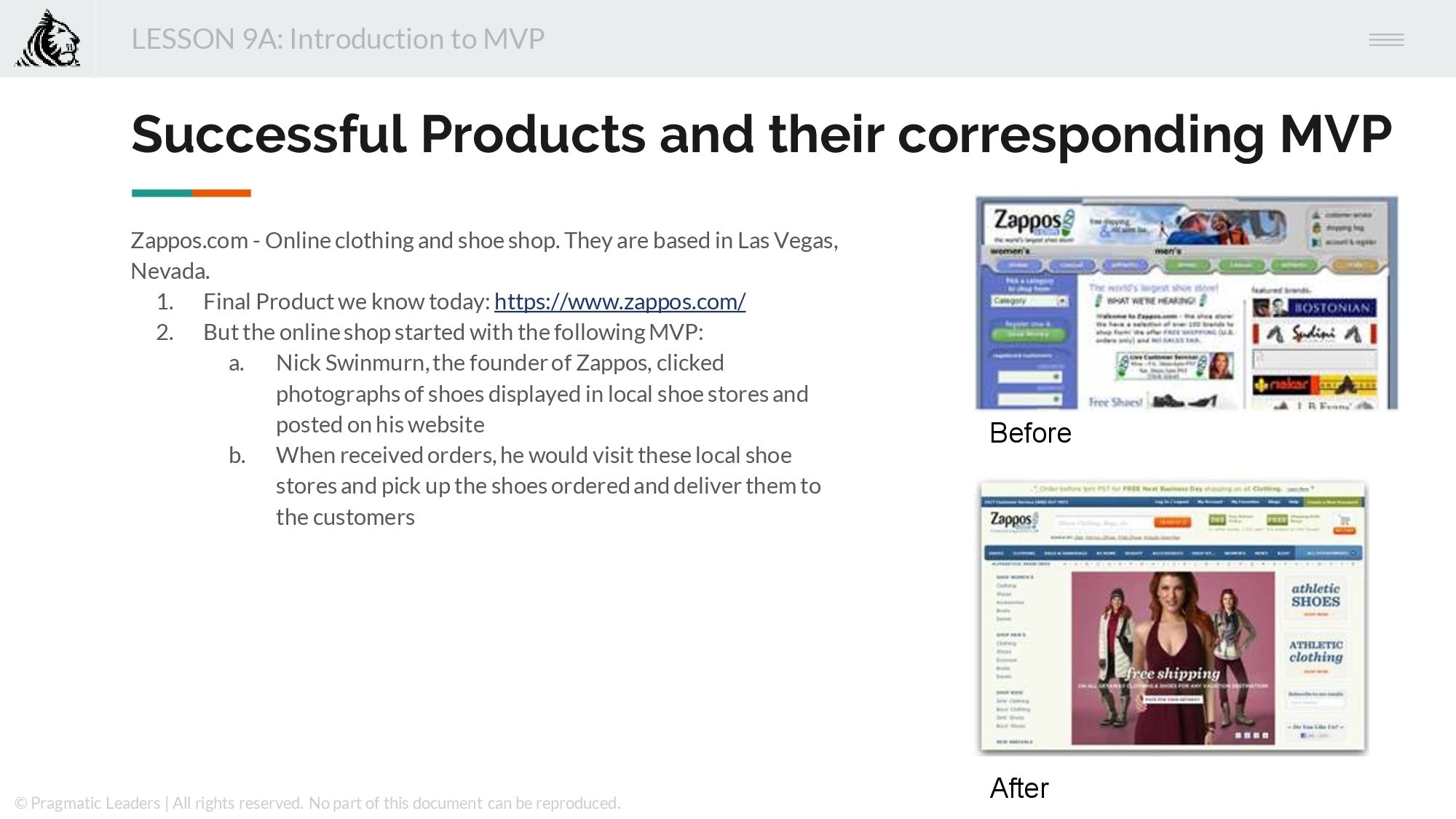
Zappos: Shoes without inventory
Zappos started as a simple website where the founder photographed shoes from local stores. When a customer ordered, he bought the shoes from the store and shipped them himself.
No inventory, no complex backend — just a way to test if people would buy shoes online.
This MVP validated the core assumption and allowed Zappos to scale confidently.
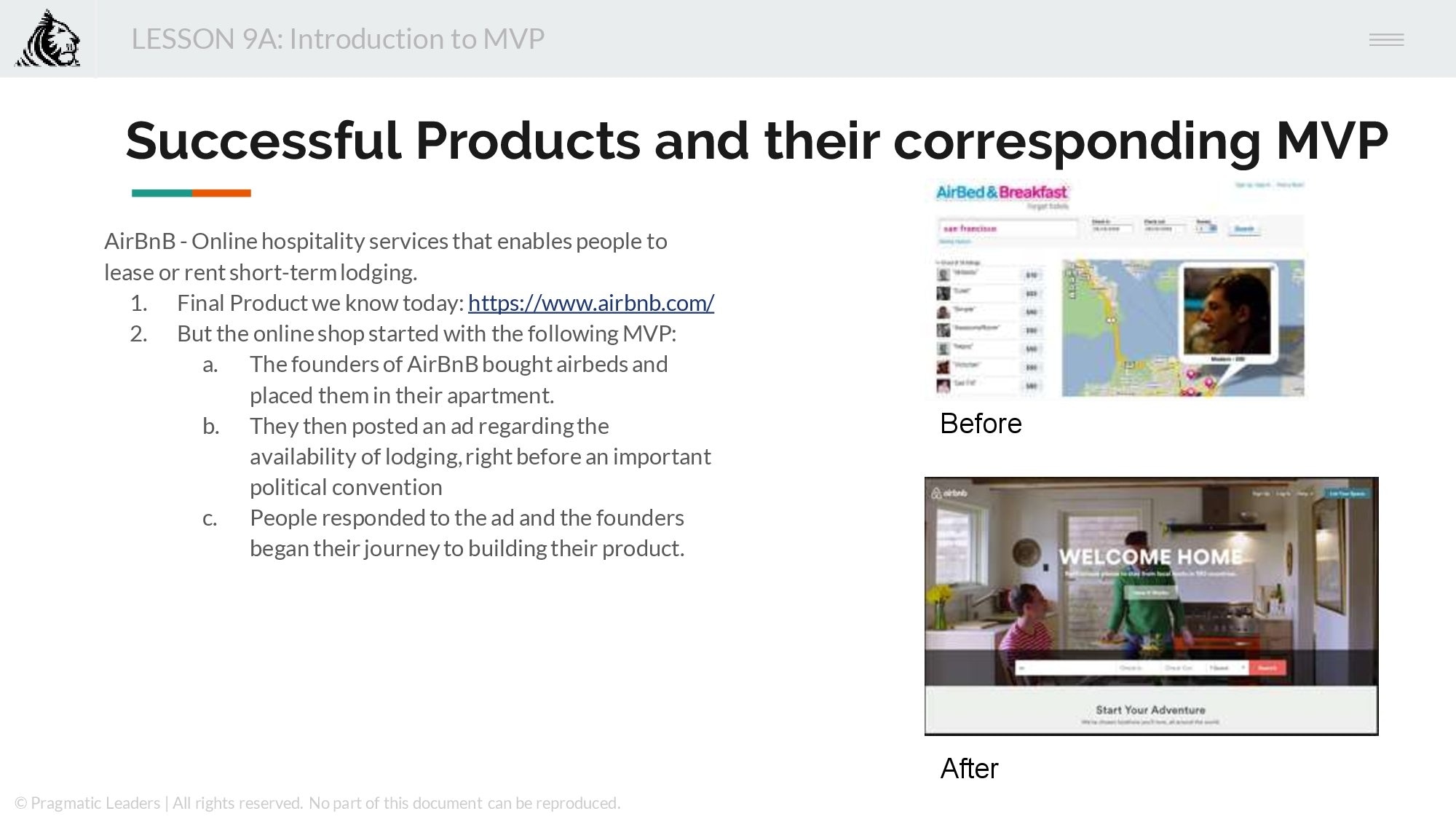
Airbnb: Renting air mattresses
Airbnb founders started by renting out air mattresses in their living room during a political convention, posting an ad online.
This simple MVP tested demand for short-term lodging, long before building a full platform.
The MVP mindset: build to learn, not to launch
Many teams make the mistake of building a full product from day one — hoping to impress users. The problem: 50% of products or features fail because assumptions were never tested early.
The MVP is your tool to avoid that trap. It is a way to fail fast, cheaply, and learn often.
If you cannot answer the question: What is the riskiest assumption this MVP tests? you are not ready to build.
Field Exercise: Design your MVP experiment (Time: 20 minutes)
Take a product idea you are working on or considering. Walk through these steps:
- Identify your target early adopters. Who are the Innovators and Early Adopters for this product?
- List your top 3 riskiest assumptions about this product and its users.
- Write measurable hypotheses around each assumption.
- Design the smallest possible product or experiment to validate these hypotheses.
- Decide how you will collect feedback and measure success.
- Plan your iteration cycle based on what you learn.
Write down your answers and be ready to discuss how this MVP will help you learn faster.
Test yourself: MVP prioritization dilemma
You are the PM at a Bangalore-based Series A SaaS startup. Your team wants to build a full-featured dashboard with analytics, notifications, and integrations. Your budget and time are limited. You must decide what to build first as an MVP.
The call: Which features do you include in the MVP to maximize validated learning with minimal effort?
Your reasoning:
You are the PM at a Bangalore-based Series A SaaS startup. Your team wants to build a full-featured dashboard with analytics, notifications, and integrations. Your budget and time are limited. You must decide what to build first as an MVP.
Your task: Which features do you include in the MVP to maximize validated learning with minimal effort?
your reasoning:
Where to go next
- If you want to master user-centered product discovery: User Research Methods
- If you want to learn how to prioritize ruthlessly: Prioritization Frameworks
- If you want to build and validate hypotheses systematically: Lean Product Experimentation
- If you want to understand product-market fit deeply: Product-Market Fit